

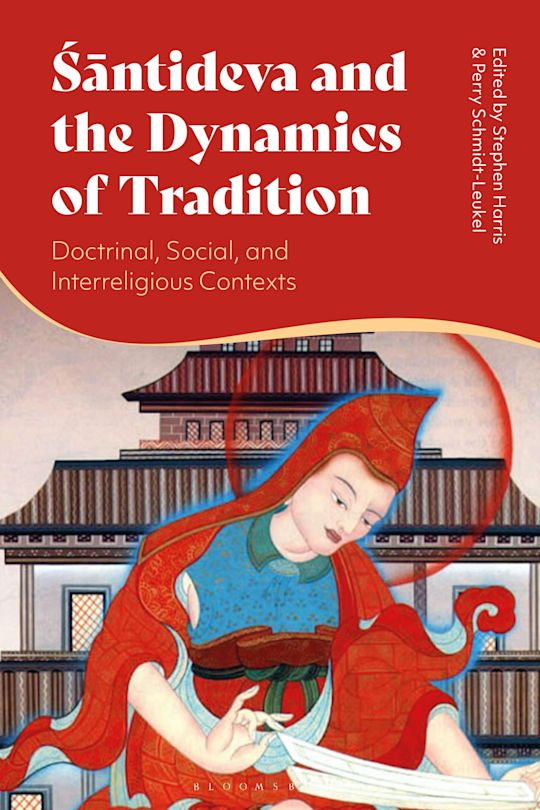
Stephen Harris /
Perry Schmidt-Leukel (eds):
Shantideva and the Dynamics of Tradition. Doctrinal, Social, and Interreligious Contexts
London: Bloomsbury 2025, 266 pp., index
| Ebook (PDF) | |
| ISBN | 9781350532342 |
|---|---|
| Verlagsinformation | Details >>> |
Ergänzend / See also:
>>> Perry Schmidt-Leukel: Christlicher Kommentar zu einem Zentraltext buddhistischer Spiritualität (IRB Blog-Archiv)>>>
>>> Ausführliche Rezension (IRB Blog-Archiv)>>>
>>> Mehr zu Perry Schmidt-Leukel (University Münster): Neue Zugänge zu einer interreligiösen Theologie (IRB Blog-Archiv)>>>
>>> Mehr zu Stephen E. Harris (Leiden University) >>>
DESCRIPTION
This collection analyses the dynamic role of tradition in understanding the thought and impact of the 8th century Mahayana Buddhist thinker Shantideva.
Organised into three interconnected sections, it highlights Shantideva’s Guide to the way of life of a Bodhisattva (Bodhicaryavatara) as a product of and major contributor to the 7th and 8th-century Mahayana Buddhist intellectual tradition.
Across a series of cross-cultural case studies, a team of philosophers and scholars of religion demonstrate how the Guide, a religious and philosophical classic, is being taken up into contemporary academic conversations. They analyze key Buddhist concepts developed by Santideva,including effort, compassion, wisdom and the spirit of awakening (bodhicitta), explicating the role they play in his thought and the impact they made on the tradition. Covering his attitude towards woman, they discuss his use of sarcasm revealing his conception of human beings and examine social hierarchy as reflected in his writings and traditional biography.
Unique in the attention it gives to social dynamics, this is the first collection to incorporate interreligious dialogue into its framing of the Guide. This interdisciplinary approach showcases the benefits of employing multiple methodologies in the study of Santideva’s thought. A valuable addition to cross-cultural philosophy, Buddhist ethics, interreligious dialogue and Mahayana Buddhism.
Table of Contents / Inhaltsverzeichnis
Contents — Notes on Contributors
Introduction — Stephen E. Harris, Perry Schmidt-Leukel
I. Doctrinal Dynamics
1. Candrakirti’s prajna, Santideva’s phronesis:
Alternative Models of Madhyamika Wisdom — Amber D. Carpenter
2. Suffering and Liberation on Santideva’s Bodhisattva Path — Stephen E. Harris
3. The Wind in the Sails: Virya in the Bodhicaryavatara — Jay L. Garfield, Emily McRae
4. Immanence and Transcendence: Ethical Grounds in Prasangika and the Great Perfection
— Douglas Duckworth
II. Social Dynamics
5. Santideva’s Idea of the Yogic and Non-Yogic Worlds:
Its Implications and Possible Antecedents
Dorji Wangchuk
6. Mockery, Sarcasm, and Irony in the Bodhicaryavatara — Perry Schmidt-Leukel
7. A Feminist Buddhist Perspective on Shantideva’s Bodhicaryavatara
— Carola Roloff (Bhikkhuni Jampa Tsedroen)
8. Hierarchy Versus Charism:
Santideva’s Hagiography as an Exemplar of the Tension in Buddhism Between Ecclesiastical Status and Spiritual Attainment — Andrew Skilton
III. Interreligious Dynamics
9. Santideva’s Twofold bodhicitta in Light of Comparative Spirituality — Francis Brassard
10. Sa?kara and Santideva on Consciousness and Ultimate Reality:
A Field Guide to Identify the Buddhist Advaitin — Fabian Völker
11 Learning To Be Empty: Shantideva’s Wisdom on Creaturely No Self — S. Mark Heim
12. Compassionate Ethics and Contemplative Dynamics:
Some Observations on Shantideva’s Bodhicaryavatara and Zayn al-‚Abidin’s Makarim al-akhlaq
— Reza Shah Kazemi
Index