

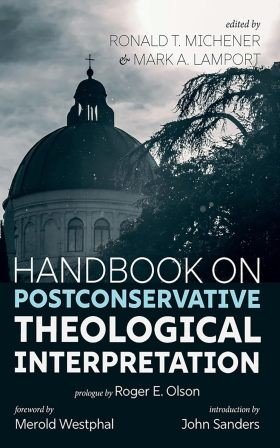
Ronald T. Michener (author) / Mark A. Lamport (ed.),
Merold Westphal (Vorwort), John Sanders (Einleitung)
Handbook on Postconservative Theological Interpretation
Eugene, OR (USA): Cascade Books [Wipf and Stock] 2024, 1129 pp.
ISBN-10 : 1666744050 — ISBN-13 : 978-1666744057
| — Inhaltsverzeichnis & Leseprobe >>> — Das Thema „Hermeneutik“ in der Interreligiösen Bibliothek (IRB) – (Materialzusammenstellung) >>> — Kulturbrüche – Gottesbilder vor Herausforderungen & Risiken: Post-Christentum – Post-Theismus – Post-Säkularismus >>> |
Description
Postconservative theology may be said to parallel with “postliberal theology” at its best. Orthodox, biblical, but open to new insights about how to interpret Scripture. But the new insights must be faithful as well as fresh. Postconservative theology is not the same as „progressive theology,” which tends to lean toward indeterminant faith expressions, whereas “postconservative” allows for particular faith commitments and expressions but understands that the constructive task of theology is never finished. Authors emphasize various interpretive theological lenses used for doing theology among various postconservative theologians, rather than emphasizing the philosophical background to hermeneutical theory present in other works, such as past influential thinkers (including Gadamer, Grondin, Ricoeur, Heidegger, etc.). This resource could also function as a companion to Evangelical Theological Method: Five Views (2018). This emphasis of the chapters will not be on the nuts and bolts of “how to” interpret, but rather on the theological impulses that govern various lenses (Bible, cultural context, etc.) for doing theology and the way Scripture functions with respect to the practice of interpretation.
Beschreibung
Man könnte sagen, dass die postkonservative Theologie in ihrer besten Ausprägung der „postliberalen Theologie“ entspricht. Sie ist orthodox, biblisch, aber offen für neue Erkenntnisse hinsichtlich der Auslegung der Heiligen Schrift. Diese neuen Erkenntnisse müssen jedoch sowohl zuverlässig als auch neuartig sein. Die postkonservative Theologie ist nicht mit der „progressiven Theologie“ gleichzusetzen, die dazu neigt, sich in Richtung unbestimmter Glaubensäußerungen zu bewegen, während die „postkonservative“ Theologie zwar konkrete Glaubensbekenntnisse und -äußerungen zulässt, aber versteht, dass die konstruktive Aufgabe der Theologie niemals abgeschlossen ist. Die Autoren legen den Schwerpunkt auf verschiedene theologische Interpretationsansätze, die von verschiedenen postkonservativen Theologen in der Theologie angewandt werden, anstatt den philosophischen Hintergrund der hermeneutischen Theorie zu betonen, wie er in anderen Werken zu finden ist — beispielsweise bei einflussreichen Denkern der Vergangenheit darunter Hans-Georg Gadamer, Jean Grondin, Paul Ricoeur, Martin Heidegger usw..
Dieses Werk könnte auch als Begleitband zu „Evangelical Theological Method: Five Views“ (2018) dienen. Der Schwerpunkt der Kapitel liegt nicht auf den praktischen Details der Auslegung, sondern vielmehr auf den theologischen Impulsen, die die verschiedenen Perspektiven (Bibel, kultureller Kontext usw.) der Theologie bestimmen, sowie auf der Rolle, die die Heilige Schrift im Hinblick auf die Auslegungspraxis spielt.
The Authors / Über die Autorenschaft und weitere Mitwirkende
Roger E. Olson is emeritus professor of Christian theology at Baylor University’s Truett Theological Seminary. He is the author of numerous books including The Story of Christian Theology (1999) and The Mosaic of Christian Beliefs (2002). He has taught numerous courses on cults and new religions.
Ronald T. Michener is professor and chair of the department of systematic theology, Evangelische Theologische Faculteit, Leuven, Belgium. His research focuses broadly on the interplay between postmodern philosophy and evangelical theology. Publications include Postliberal Theology: A Guide for the Perplexed (2013); The Matrix of Christian Ethics: Integrating Philosophy and Moral Theology in a Postmodern Context (2010, with Patrick Nullens); and Engaging Deconstructive Theology (2007). Mark A. Lamport has been a professor at graduate theological schools in the United States and Europe for forty years. He is coauthor of Nurturing Faith: A Practical Theology for Educating Christians; coeditor of the seven-book series The Global Story of Christianity (2022-24); editor of Handbook of Philosophy and Religion (2022); Handbook of Contemporary Christianity in the United States (2022); Christianity in the Middle East (2020); Encyclopedia of Christianity in the Global South (2018); Encyclopedia of Martin Luther and the Reformation (2017); Encyclopedia of Christianity in the United States (2016). He works from Grand Rapids and Fort Myers.
Mark A. Lamport has been a professor for nearly forty years at theological schools in the United States and Europe. He is coauthor of Nurturing Faith: A Practical Theology for Educating Christians (2021), coeditor of the seven-book series The Global Story of Christianity, and coeditor of Emerging Theologies from the Global South (2023). He works from Grand Rapids and Fort Myers.