Bin Liu (Autor), Luoying Zheng (Übersetzer)
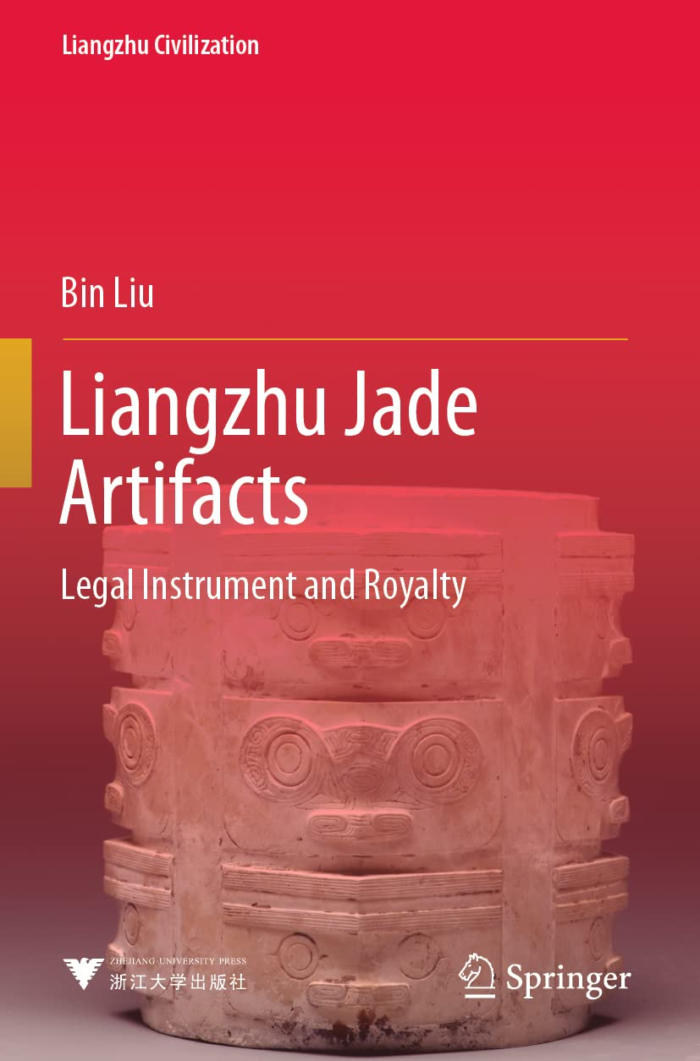
Liangzhu Jade Artifacts: Legal Instrument and Royalty (Liangzhu Civilization)
[Jade-Artefakte aus der Liangzhu Civilization
Rechts-Instrument und Rangzeichen des Königtums]
Heidelberg: Verlag Springer Nature 2023, 168 S.
Teil von: Liangzhu Civilization (6 Bücher)
ISBN 10 – 9811902941 — ISBN 13- 978-9811902949
— Inhaltsverzeichnis und Leseprobe >>>
Xiangming Fang:
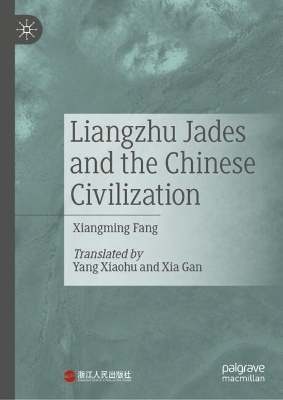
— Liangzhu Jades and the Chinese Civilization
Heidelberg Verlag Springer Nature 2026, 464 S., 147 illustr. color, 51 illustr. s-w
ISBN-10 – 981-92-1013-5
ISBN-13 – 978-981-92-1013-8
INHALT
1. Jade Artifacts: The Key Elements in the Origins of Chinese Civilization.
2. Liangzhu -The Most Advanced Jade-Using Cultures of China.
3. The Jade Age and the Origin of Chinese Civilization.
Description of the book: Liangzhu Jade Artifacts
This book provides the reader with the latest archaeological discoveries of Liangzhu culture (3300 – 2300 B.C.) for its sophisticated jade artifacts. The structure and contents systematically present that large-scale ritual vessels such as jade cong and bi were originally regarded as the embodiment of Zhou and Han dynasties have been proved as burial accessories of Liangzhu culture. This confirmation urges archaeologists to renew an earlier interpretation of societal development dimension in Liangzhu culture. The book discussed the compatibilities between types and function of Liangzhu jades vividly displayed. It provides archaeological researchers and students by gaining an in-depth perspective of aesthetic appreciation of jade while understanding of the spiritual world of people in Liangzhu as well as the transition between the functions of power and belief.
Autoren
Bin Liu, Head of Zhejiang Provincial Institute of Cultural Relics and Archaeology and Director of the Conservation Center for Liangzhu Archaeological Site, has participated in several archaeological excavations at well-known sites, such as Fanshan and Yaoshan in Yuhang, Zhejiang Province, and Zhongbao Island in Yichang, Hubei Province. He has also presided over excavations of various Neolithic heritage sites, like Heye Land and Shedun Temple in Haining, Huiguan Mountain in Yuhang, and Nanhebang in Jiaxing, Zhejiang Province. From 2006 to 2007, he led the drilling survey at Liangzhu site and discovered the ancient city of Liangzhu.
His major works include:
— Nanhebang: Report on Excavation of Songze Cultural Heritage (Cultural Relics Press, 2005)
— Complete Collection of Chinese Unearthed Jade Artifacts, Zhejiang Volume (Science Press, 2005);
— Liangzhu Culture: World of Sorcerer (Zhejiang Photography Press, 2007).
Hintergrund
— Dossier China — Religionen & Vielfalt der Kulturen (IRB Blog-Archiv / Open Access)
— China – eine dreitausendjährige Geschichte (IRB Blog-Archiv) >>>
Die spirituelle und kulturelle Bedeutung der Jade
— Kulturgeschichte der Edelsteine (Buchpräsentationen mit Fotos) >>>
— Jade: Stein der Ewigkeit, vom chinesischen Kaiser zur Pflege von Körper und Seele (Terre de Siam) >>>
— Symbolkraft der Jade: Chinese jade (wikipedia.en)
— Vgl.: Chinesische Bronze-Kunst im Horizont von Religion Macht und kultureller Identität (in Vorb.)
Zum Verständnis der Jade-Congs
Die beeindruckenden Artefakte aus dem Neolithikum und dann besonders die sog. (Jade-)Congs, [auchT’Sung/Zhong] aus der Liangzhu Kultur (3300 – 2300 v. Chr.) sind in ihrer Bedeutung nicht völlig geklärt. Sie wurden wahrscheinlich als Ritualobjekte bei Opfer- und Beerdigungszeremonien benutzt. Als röhrenförmige Zylinder wurden sie in späterer Zeit als Darstellung für Himmel und Erde angesehen (vgl. Jade Cong, Smarthistory) und spielten als religiös-politische Status- und Machtsymbole eine wesentliche Rolle.

— Yin (Himmel) und Yang (Erde) – wikipedia >>>
— Himmel-Erde-Mensch und die sechs Harmonien (Path of Dao) >>>
— Laotse und der Daoismus (IRB-Archiv) >>>
„An ancient Chinese jade artifact. The earliest cong (pl.) were produced by the Neolithic Liangzhu culture. Later examples date from the Shang (ca. 1500–1050 BCE) and Zhou (ca. 1046–256 BCE) dynasties. In form, a cong is a hollow cylinder embedded in a rectangular block. Proportions vary: some cong are squat, others are taller than they are wide. The outer surfaces are sometimes decorated with mask-like faces. Although generally considered to be ritual objects, the original function of the cong is unknown. Web resource here (Smarthistory)“
Jade Cong. Liangzhu culture. Ca. 2500 BCE. Private Collection (Text und Foto: Art History Glossary)

Weitere Beispiele von Congs und Ritualgefäßen aus Jade (Nephrit)
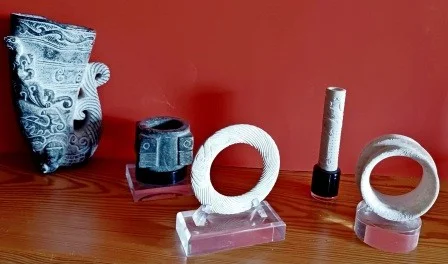
Von links nach rechts:
– Opferschale
(Shang-Dynastie, 1766-1121 v. Chr.
– Cong, quadratische Form für Erde,
Rundung für Himmel
— Jade-Ring
(Bi-Scheibe?, vermutlich, Grabbeigabe)
— Cong, röhrenförmig: Himmelszeichen
— Jade-Ring, Grabbeigabe (Shang-Dynastie)
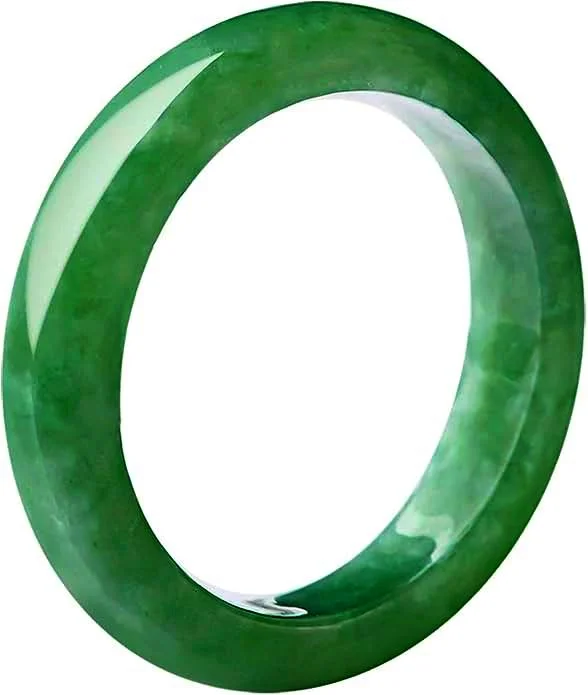
— Grüner Jade-Ring